Opal Body Tone Explained (N1–N9)
Body tone is the underlying darkness of a precious opal, judged independent of the play-of-colour that floats on top. It is graded on a standard scale from N1 (jet black) to N9 (white), with a special non-applicable code (N10) for stones where body tone cannot meaningfully be assessed (such as boulder opal, where the ironstone host is part of the gem). Body tone is one of the largest single drivers of an opal's value — for two stones with similar brightness, the darker base will almost always carry the higher per-carat price.
What body tone actually measures
When you look at a precious opal you see two layers at once: the play-of-colour — the moving spectral flash phenomenon — and the body beneath it. Body tone is the colour of that body, ignoring the play-of-colour. The standard test is to view the stone face-up under diffuse white light and mentally subtract the fire.
Body tone is a property of the opal itself, not a treatment or a finishing step. A stone's body tone is fixed from the moment it formed in the ground; cutting and polishing reveal it but do not change it.
The N1–N9 reference scale
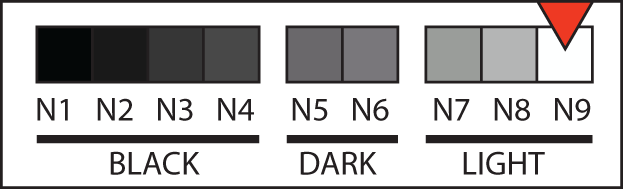
The scale was standardised by the Australian opal industry to give buyers and sellers a common vocabulary. There are nine principal levels grouped into three families. The icons below show approximate appearance only — in person, body tone should always be judged on the stone itself, in good light.
| Swatch | Code | Description | Family |
|---|---|---|---|
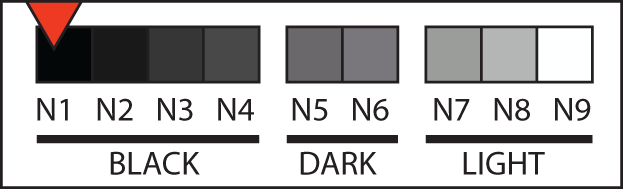 | N1 | Jet black, deepest end of the scale | Black |
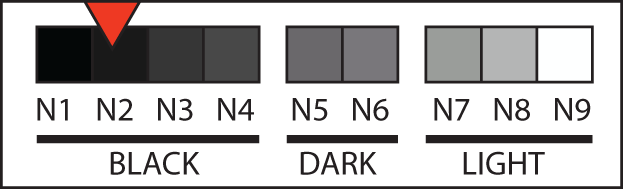 | N2 | Very dark, nearly black | Black |
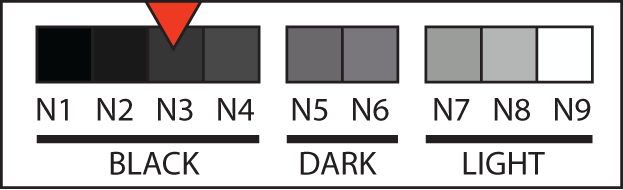 | N3 | Dark | Black |
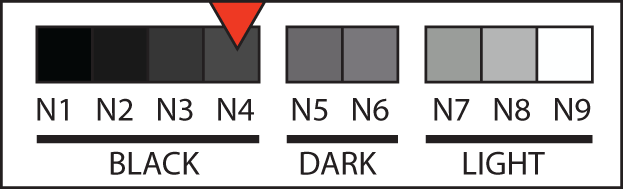 | N4 | Dark grey | Black |
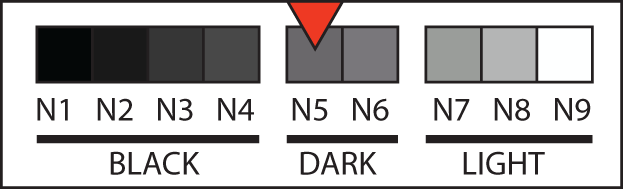 | N5 | Medium-dark grey | Dark |
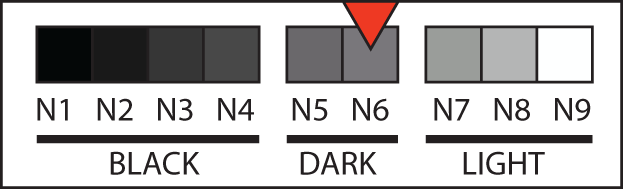 | N6 | Medium grey | Dark |
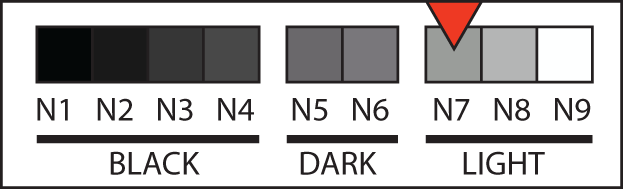 | N7 | Light grey | Light |
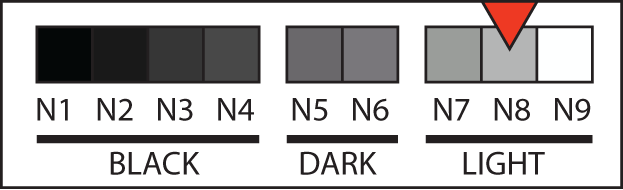 | N8 | Very light, off-white | Light |
 | N9 | White | Light |
Three families: Black (N1–N4), Dark (N5–N6), Light (N7–N9). N0 indicates “no data” (not yet assessed) and N10 indicates “not applicable”.
Why body tone matters for value
The same play-of-colour appears more vividly against a darker background. A spectral red, green or blue flash with a black base has high contrast; the colour seems to leap off the stone. The same flash on a white base appears softer and washed-out by comparison. That contrast effect is the reason black opal (N1–N4) commands a substantial premium over light opal (N7–N9), per carat, all else being equal.
Within the black family, the difference between an N1 and an N4 can still be significant, but the premium narrows rapidly. The largest valuation step is the move from N5 (dark) to N4 (black), because that crosses the line into “black opal” in the trade sense.
Body tone is not brightness
The most common mistake buyers make is to confuse body tone with brightness of fire. The two are independent:
- Body tone is how dark the underlying base is.
- Brightness is how vivid and intense the play-of-colour is when viewed in good light.
A dull N3 black opal can be worth less than a brilliant N7 light opal. Brightness almost always trumps body tone when the gap is wide. The ideal — rare and valuable — is a stone that is both dark-bodied and bright. See our classification reference for the brightness scale we use.
How to judge body tone in practice
Body tone is judged with the play-of-colour mentally removed. In practice that is hard to do, because the eye is drawn to the colour-play. A few techniques used in the trade:
- View under diffuse white light — daylight from a north-facing window, or a colour-balanced 5000–6500K lamp. Avoid coloured or yellow light, which biases perception.
- Tilt the stone past the colour-play angle, so that the spectral flash is momentarily extinguished. The bare body tone is then visible.
- Compare side-by-side against a known reference stone or against printed swatches. The relative judgement is far more reliable than the absolute.
- Look at the side of the stone where polishing exposes the body without the dome of colour-play sitting on top.
For boulder opal (precious opal naturally attached to ironstone), the body-tone scale is not usually applied. The ironstone backing provides its own dark background, and grading focuses on the brightness, pattern and proportion of the opal face instead. See our types of Australian opal guide for more on boulder opal.
Body tone and the source of the stone
Body tone correlates loosely with mining origin. Speaking generally:
- Lightning Ridge (NSW) is the principal source of N1–N4 black opal.
- Coober Pedy (SA), Mintabie and Andamooka produce most of the world's N6–N9 light and crystal opal.
- Lambina (SA) historically produced a mix, including some dark stones.
- Queensland fields produce boulder opal (body tone not graded on this scale).
Plenty of exceptions exist. Coober Pedy occasionally yields dark-bodied stones; Lightning Ridge produces light and crystal opal alongside its famous blacks. Body tone is a property of the stone, not the field.
Common mistakes and trade-language pitfalls
- “Black opal” as a marketing term. The term should refer to body tone in the N1–N4 range. Some sellers describe N5–N6 stones as “semi-black”, which is acceptable, but the term “black opal” properly belongs to the darker family.
- “Black crystal opal” is a real and very rare category — a crystal opal (transparent) with a dark body tone. It is distinct from black opal (opaque dark body).
- Doublets and triplets can mimic a dark body tone using a black backing on a thin slice of light opal. Body-tone language refers to solid opal; doublet/triplet construction must always be disclosed.
- Treated matrix opal (the Andamooka sugar/acid process) creates a dark host that imitates a low body tone. Disclosure of treatment is mandatory in reputable trade.
Body tone in the Christianos Opals inventory
Every solid stone in our catalogue is assigned a body tone code from the scale above. When you browse our inventory, the body tone is shown next to the type and dimensions; when you read one of our certificates the body tone is recorded on the certificate alongside the brightness, dimensions and weight. The body tone we record is our own assessment using the scale and methods described on this page.
Use Comprehensive Search to filter our current stock by body tone family (Black / Dark / Light), or browse the full classification tables for the other scales we apply.